
The Grape Doesn’t Read the Analysis
I haven’t said much for months. Then this vintage showed up and started fooling me.

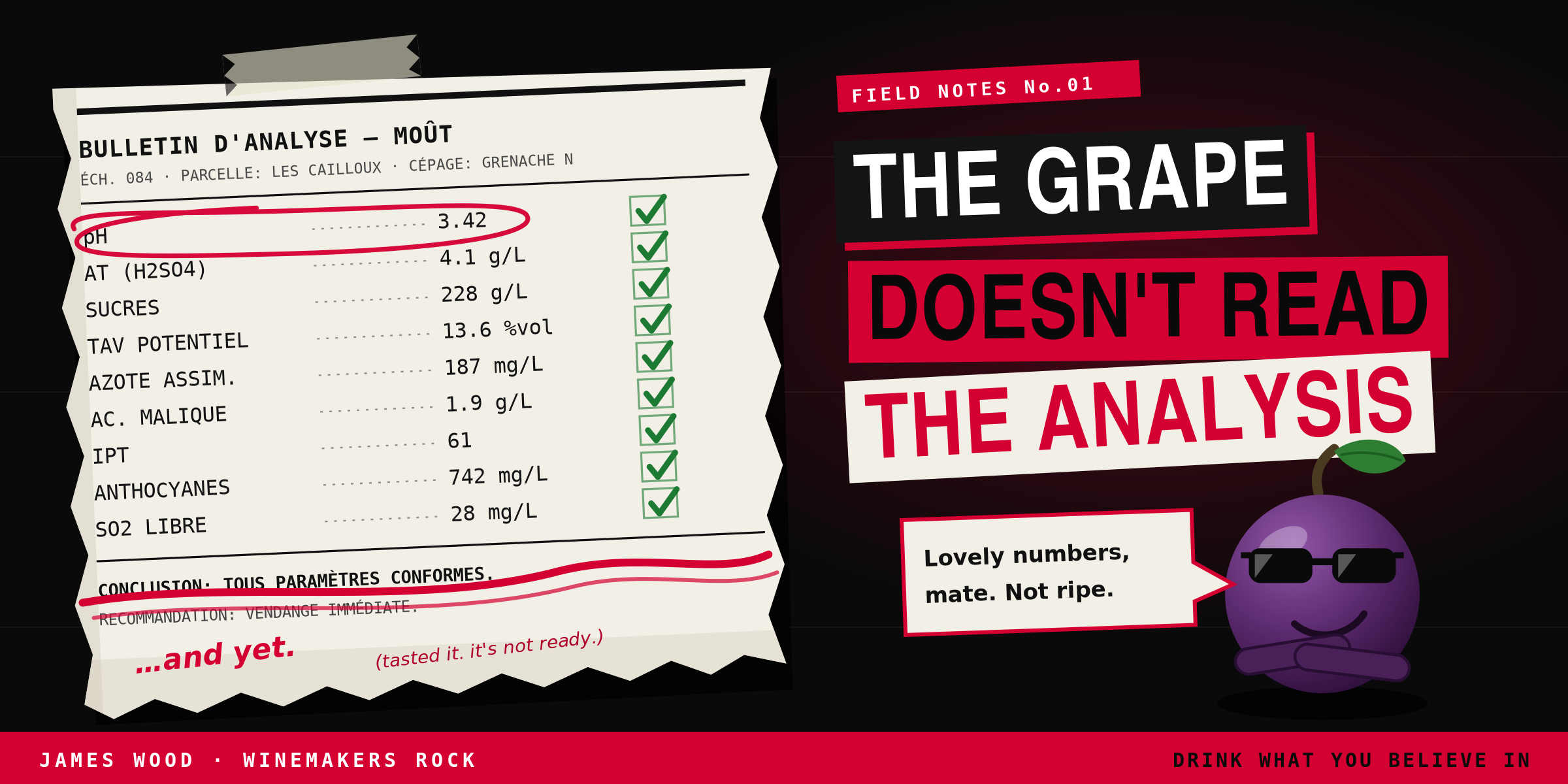
Right. It’s been a while.
I wish I could say I’ve been relaxing somewhere sunny with my phone off, but that’s not the case. Instead, it’sbeen busy—family and friends visiting, everyone chasing the southern romance and a good glass of wine, all while I’m building a wine business, running a cellar, chasing payments, and handling paperwork in two countries. Writing kept getting pushed aside. Then the 2026 vintage season arrived, and the grapes started acting up.
May brought the earliest heat of my time here—the first May in history that Météo-France issued a canicule warning, with over half its stations breaking their May record. Three official heatwaves since June, and the last one rolled straight into August.
So here I am, back at the keyboard. I’m a bit tanned, but not bronzed—no one in their right mind would spend much time in the sun these past four months. Someone needs to write down what’s really happening in these vineyards, not just what the press release will say in November.
Just a heads up: this piece has some numbers. I’ll also talk about how the regenerative movement has been repeating a made-up statistic for thirty years. Stay with me. I do waffle a bit as I get deeper into articles and updates, but it is all relevant to the now, and to understanding climate and viticulture with regards to harvest.
Picture this. 07.30 in the morning, southern Rhône, already warm enough to be sweating like a hallucinating teenager on mushrooms!
You crush a grape sample and check it with the refractometer. The reading you get would have had us picking two weeks ago.
Sugar levels are soaring. The numbers are rising week after week, faster than I’ve seen since I started here in the region in 2008. On paper, the vineyard looks like it’s had a fantastic summer.
But here’s the twist: walk fifty metres into the vineyard, and things look completely different. The grape bunches are small—really small. The berries never grew to full size. If you squeeze one, you barely get any juice. Same vineyard, same morning, but two totally different stories. The older growers say the last time it was like this was 2003. I wasn’t here then; I’ve only heard the stories, usually over a third glass of wine, and the details change every time. So I’ll leave that comparison to them and focus on what I see now.
The numbers are going up, but for the wrong reason. Sugar in a grape can increase in two ways, and they mean very different things. The first is accumulation: the vine photosynthesises and sends sugar to the berry through the phloem. That’s real ripening—the good kind.
The second way is concentration. The berry loses water faster than it absorbs it, so the sugar inside just becomes less diluted. That’s not ripening—it’s just evaporation dressed up as something better.
Here’s something every refractometer should remind you: phloem unloading into the berry doesn’t just slow down—it stops completely. Research published in 2021 tracked this directly. Water, sugar, and potassium all stop entering the berry at the same time, and that’s final. Earlier studies that showed sugar rising afterwards were misleading—they mixed berries at different stages.
Depending on how you look at it, things either get better or worse from here. In the same study, Syrah grapes in the field actually lost sugar per berry after the stop—it was respired away in the heat. Meanwhile, the Brix reading kept going up. The numbers and the fruit were moving in opposite directions at once. That sums up this vintage. None of this shows up in a refractometer reading.
The real clue is in the scales, not the optics. Track berry weight as well as sugar. When the weight levels off and starts dropping while Brix keeps rising, the vine has stopped delivering. At that point, you’re measuring dehydration, not ripeness. If you only look at sugar, you can’t tell which is which.
The berries made this decision back in late May or June.
Let me mention Ojeda, since I’ve been relying on his research and it’s helped me double-check my instincts lately. Hernán Ojeda is a researcher at INRAE’s Pech Rouge station on the Languedoc coast. He spent years carefully measuring what water deficit really does to grape berries, rather than relying on assumptions. People thought drought stopped the berries from dividing cells, so you’d get fewer cells. But Ojeda’s team found that cell division was mostly unaffected. What actually shrank was the cell volume, because the cell walls couldn’t stretch as much. The berries didn’t lose a generation of cells—they just couldn’t expand the ones they had. This matters in practice: if there’s a water deficit between flowering and veraison, the berries stay smaller for good.
Even if you water the vines generously afterwards, the fruit doesn’t regain its size. Late rain can still help berry weight a bit, but it can’t make up for what was lost in spring and early summer.
So the small berries I’m holding in August were already determined back in May or June, while I was focused on other things. They’re not a problem to fix now—they’re just a fact to work with. Small berries have pros and cons. Less pulp means less dilution from the skin, so the juice is more concentrated.
But that doesn’t mean you get better quality for free—you’re just concentrating what’s already there. The wine trade often assumes small berries are always better, but research is less sentimental. In several trials, medium-sized berries actually tasted best. Small berries are great when the skins are ripe, but they’re a problem when they’re not.
Sugar is not the only thing moving in a heatwave. Other dynamics shift and start to work against you. Malic acid gets respired away faster as temperature climbs. Straightforward enzyme kinetics. Total acidity drops, pH drifts up. Potassium is doing its own damage alongside. It binds up tartaric acid as tartrate salts and pushes juice pH higher still; late in ripening, that’s often the bigger lever of the two.
High pH is not a stylistic inconvenience. It is a microbiological one. It eats your molecular SO2, and you pay for it in the cellar. Colour takes a hit too, and earlier than most people think.
Anthocyanin synthesis peaks somewhere around 30°C; above that it’s already being suppressed. The damage does not politely wait for 35. And at sustained high temperatures, the vine doesn’t just make less. It loses what it already made. Mori’s team labelled anthocyanins with 13C before applying heat, but the existing pigment still declined.
Now remember a sun-exposed berry can sit 10 to 15°C above ambient air temperature. Think of the car dashboard or sitting still directly in the sun with no air flowing. It’s the same for a little berry. The west-facing side of a row can be going backwards on colour while your analysis sheet looks perfectly cheerful.
Add it up. High potential alcohol, low acid, high pH, phenolics trailing behind. Seeds still green. Tannin gripping in the wrong way. Each of those is invisible on a sugar reading.
And it isn’t just us. This is a national story, not a Rhône sob story. Jérôme Despey is a Hérault vigneron and chairs FranceAgriMer’s conseil spécialisé vin et cidre. He puts irrigated vineyards at barely 15 per cent of France’s planted surface area.
The last official census had it lower, at 8.9 per cent in 2020, though it is climbing fast. Take either number. The point survives. The overwhelming majority of French vineyards take the summer exactly as it comes. Unirrigated blocks have been shedding leaves under water stress. Berry weights are below average in several regions. Those that can irrigate are boxed in by the AOC calendar, and they pay for it in yield—Côtes du Rhône drops your ceiling from 9,500 to 6,500 kilos a hectare the moment you turn the taps on. The rules are not chasing volume. They are rationing it.
Then the clearest signal of all. Agreste, the ministry’s statistical service, normally publishes its harvest forecast in early August. This year it delayed the number until 8 September to see real harvest data before committing to a figure.
Despey’s explanation is better in his own words than mine. “On pensait avoir une très grande précocité, ce qui n’est pas tout à fait le cas parce qu’il y a eu des blocages de maturité liés aux fortes chaleurs.”
We expected a very early vintage. We got maturity blocked by heat instead. When the people whose job is to publish the number decline to publish it, that tells you something about the number. One genuinely good thing, and it deserves saying plainly. The fruit is clean. Disease pressure has been low and sanitary conditions are close to optimal. Powdery mildew (Oidium) is worth watching where the nights go humid. Nothing like a normal year’s fight. Dry heat is miserable for volume and glorious for health…..That part, we’re calm about.
Analysis is not the enemy. Let me open the other side because I am not about to romanticise ignorance. Analysis is how you compare plots on the same basis. It’s how you see a curve rather than a snapshot. It’s how you spot the block accelerating away from its neighbour round the corner. It’s how you book pickers, plan tank space, and stop yourself making an emotional decision at six in the morning on four hours’ sleep and a litre or two of cold beer.
Strip the numbers out, and you are not a purist. You are guessing with a nicer story attached. I wouldn’t run a harvest without them. Neither should anyone else. But a measurement measures one variable. Ripeness involves at least five, and they do not move in step. The number is a witness, not a judge.
So we taste
Before anything gets picked, we eat the grapes properly, plot by plot, walking the block rather than the headland. Pulp first. Does it release from the seed? Is the fruit present or still all acid and green apple? Skin next. Chew it. Does the tannin give you something fine and sweet, or something drying and hard? Then the seed. Still green and crunchy, or brown, lignified and nutty? Pip colour has told me more about pick dates than any single analysis I have run. So we pick by plot. Always, but this year more than ever.
I know of picking dates that have been set to holiday availability months in advance, and also of picking crews that arrive on the same day and period every year, then sit around cleaning the cellar floors or building structures, as the grapes aren’t ready, and sometimes they have to leave without picking a single grape because the fruit never got ripe in their window. That is brave of the vigneron to hold the pressure of picking back, since his picking crew is with him. And then it’s tough to get a team in place to start picking when the fruit is ready. The phrase “it depends” is engraved in our heads; any question asked always starts with “It depends”.
Two parcels in the same vineyard can take the same week of heat and respond differently. Different soil depth, different water-holding, different vine age, different aspect. One is still evolving calmly. The other will put on a degree and a half while you’re deciding. Same number, two plots, completely different meanings. We don’t harvest a degree. We harvest a grape. The hard part of 2026 is not the heat. It is accepting that the harvest will be strung out, every plot has its own clock, and squeezing a vintage into one date produces wine that analyses beautifully but tastes of nothing.
About that rain
We are all refreshing the same forecast twice a day. However, let me be clear. A few millimetres change nothing. After a drought like this, with berries that never sized, light rain is a rounding error. Real rain could shift the dynamics of some plots. But we need to understand what it can and can’t do. It cannot restart sugar delivery. Once phloem unloading stops, it has stopped. There is no mechanism by which
September rain puts sugar back into a berry. What water can do is get in through the wetted skin. That’s the documented route to rain-cracking, and more so when heat has already degraded the cell vitality of the berry surface—which, after this summer, it has. So the realistic upside is relief for the vine and its canopy. The realistic downside is dilution and splitting on fruit that is already fragile. And if it arrives as storms, you’ve bought hail risk at the worst moment in the calendar. The crop is hanging, and it’s got nowhere to hide. Rain can change the end of this story, but it can’t rewrite the beginning.
Right. So what do we actually do about it?
This is where I’m supposed to say “regenerative viticulture”, and you’re supposed to nod. Let’s do something more useful instead. Let’s find out which bits work. I have become a regenerative believer over the last decade but not a romantic one. The movement has done real damage by repeating numbers nobody checked. So I will start by breaking one.
The 20,000-gallon lie.
You probably haven’t heard of it or might have seen it. Probably on a conference slide, in a nice earthy font. “A 1% increase in soil organic matter holds an extra 20,000 gallons of water per acre.” It is not exaggerated. It is wrong and off by a factor of 5 to 10. Convert it, and the trick becomes obvious. Twenty thousand gallons an acre is 75,700 litres, which comes out at 18.7 mm of water. The claim never states over what soil depth, which is precisely where the fraud lives.
Minasny and McBratney went at this properly in 2018. Over fifty thousand measurements, plus a meta-analysis of sixty studies. A one per cent rise in soil organic carbon raises available water capacity by about 1.2mm per 100 mm of soil.
Do the arithmetic on your own topsoil. Thirty centimetres deep, one point of organic matter, and you’ve bought yourself roughly two to four millimetres of extra plant-available water.
In the Vaucluse in July, vine and soil evapotranspiration runs at five to six millimetres a day. Thirty years of soil building buys one July afternoon. Now the part nobody quotes. Later work found the effect roughly doubles on non-calcareous soils, and collapses on calcareous ones. On a medium-textured calcareous soil it’s about 1.2 mm per 100 mm. On fine calcareous soil the measured figure was slightly negative. Nothing at all.
Guess what most soil here in the Vaucluse vineyards consists of? Yep, calcareous soils.
The statistic that flatters the movement most is the one that least applies to us. Chasing the number back to the original 1994 paper is quite funny because that paper contains no gallons-per-acre figure whatsoever. Somebody invented it downstream, and everyone else copied their homework. That is not the same as saying it does not work. Because here’s my actual point. The regenerative movement picked the wrong argument.
It has been selling a water-storage claim the soil physics won’t support, while sitting on a water-capture claim that is enormous, repeatable, and directly relevant. Look at infiltration. In tilled vineyard wheel tracks, field-saturated hydraulic conductivity sits below 26 mm/ hour. One tractor pass on wet soil collapses it to somewhere between 1 and 10. Under grass, the same wheel track mostly runs above 50 mm/hour. Real-world consequence in a wet year: runoff coefficient 8% tilled against 2% grassed. Soil loss 3.1 tonnes per hectare against 0.5. Runoff down 76%. Soil loss down 83%.
Now think about where the climate is going. Not necessarily steadily drier, but fewer and angrier rain events. Annual totals here show no clear trend since 1960, yet rainfall intensity on the Mediterranean arc is up 22% since then, and events over 200 mm a day have doubled in fifty years. In that world, the binding constraint isn’t how much water your soil can hold. It’s how much of a 60 mm storm gets in rather than running down the road. A 3 mm gain in storage is trivial. Turning a 40% runoff event into a 10% one is worth twenty-odd millimetres in a single afternoon.
The one that surprised me: mulch
Straw and compost mulch under the vine is the best-evidenced water intervention I’ve come across, and a three-year Rioja trial showed soil water content up 15 to 30 per cent at 25 cm depth and 40 to 60 per cent at 5 cm depth compared with a bare control. Soil temperature dropped as much as 5°C on peak summer days. And crucially, no yield penalty. Which is more than the cover crops managed. Now the honest caveat, because it matters. Bare soil does not evaporate as quickly as you think in August. Wet-tilled soil evaporates at 5.4 mm per day immediately after rain, then falls to 1.2 mm per day after nine days as the surface forms its own dry seal. So the water saving from mulch is concentrated in the days after each wetting event. Not across the whole dry summer. What mulch is really doing in August is thermal. Five degrees off the soil protects root activity, microbial function and shallow root survival. That’s a defensible claim. “Mulch stops your soil evaporating all summer” is not. And the one I’ve had to be honest about: cover crops. This is where I’ve changed my mind, and it cost me some yield.
Cover Cropping
In a Mediterranean summer, cover crops compete. The systematic review of 272 papers found pruning weight down more than 20% in nearly half of the studies, and yield down more than 20% in one in six. The losses were concentrated in Mediterranean regions. The gains showed up in irrigated ones. Worse, water deficit under cover cropping peaked around veraison. Exactly the wrong moment. But here’s the detail that changed how I will manage it, and it’s the most useful thing in this whole narrative, even if it’s a bit of a ramble for some.
Portuguese work found that season-total water use was statistically identical between tilled and covered treatments. The competition isn’t about the annual total. It’s about when. The cover crop spends the water in spring, before budbreak and through flowering. The vine arrives in July and finds the tank empty. That’s a timing problem, and timing problems have management answers. Terminate early. Alternate rows rather than full width. Match your coverage fraction to your soil depth. Choose low-water-use species, because their spread is roughly six-fold. Get the cover off in a dry spring even if it’s barely grown, and leave it on the ground as mulch.
So my position now: winter and spring cover for infiltration, structure, erosion and biology. Off and flat on the deck before it becomes a competitor.
Not because it’s a nice compromise. Because the evidence says the benefit is in the soil and the water balance, and those two things want different management.
Regenerative isn’t a belief system. It’s a set of testable claims, and some of them fail. Saying which ones fail is how you earn the right to be believed.
The bit that actually keeps me up thinking: WHY?
France has stopped hedging. In January 2026, the government wrote its warming trajectory into the Code de l’environnement. Metropolitan France plans for +2.0°C by 2030, +2.7°C by 2050 and +4.0°C by 2100. Read that again. Four degrees is not the worst case. It’s the central planning assumption, signed into law. France warms at about 1.3 times the global average. We’re already at +1.9°C against 1900. What that means for water, from the national hydrology work now framed against those same warming levels: summer low flows down around 15% at +2.7°C and around 30% at +4°C, with the sharpest decreases in southern France.
The Rhône itself has already lost 7 to 13% of its low-flow since 1960, and the downstream reach is losing the most. Projections to 2055 indicate August flows at Beaucaire will be down 16 to 35% across most scenarios.
And the bit people forget. Alpine snowmelt and glacial melt buffer the Rhône in summer. That contribution has already passed its peak. The river’s summer safety net is a melting asset.
On heat, be careful with regional averages. They get diluted by the Alps here, and they’ll flatter us. Avignon recorded 36 days above 35°C in 2022. That’s the valley floor, and that’s the number that matters to us.
So how do we think about the future of our choice of Varieties to plant (if we are allowed) to help continue winemaking practises? ICV trialled sixteen southern European varieties across twenty-five plots in the Gard and Hérault. Gard next door, and Hérault beyond it. Their conclusion: no variety proved drought-resistant. All showed foliar symptoms under severe stress. So climatic origin does not guarantee an advantage in a new place. And even if one did, the AOC framework caps it. The VIFA mechanism allows adaptation varieties at 5% of your area and 10% of the blend, over a ten-year observation window, and you can’t name them on the label.
Côtes du Rhône has four in trial. Ventoux has one. Châteauneuf has none.
Five per cent is not an adaptation strategy. It’s a polite gesture at one.
But what can we do, and how do we see the future in helping us vignerons in the coming years fight the developing peril?
Canopy tricks. Raising the trunk and cutting canopy height sounds like water management. IFV measured it and found no impact on water stress. The remaining leaves worked harder. It’s an alcohol tool, not a water tool.
Kaolin. A treatment we can apply in the vineyard that cuts tissue temperature by 1 to 3.5 degrees and reduces sunburnt berries by 25 to 50%. Negligible effect on water stress. It’s a sunburn product. It also makes your vineyard look like it’s seen a ghost.
Shade netting. Twenty to thirty per cent less light, no measured temperature effect, but spectacular on hail and disease. Fifteen thousand euros a hectare. Buy it as insurance, not as air conditioning.
Late pruning. Genuinely delays the season by eight to twelve days. Go one growth stage too far, past the third leaf, and you are looking at 20 to 80% of the crop gone to carbohydrate depletion. Narrow window, brutal downside.
Irrigation. Banned in AOC vines from 1 May to harvest, except by annual derogation, and the derogation exists to compensate a water deficit that would damage quality. In 2025 the Rhône window ran 19 June to 15 September, with yields capped lower if you used it, and prefectoral drought orders overriding the lot. As I write, the Vaucluse basins sit between vigilance and alerte renforcée, and July rainfall here ran 60% below normal.
And now the irony I can’t get past.
Agrivoltaics — photovoltaic panels over the vines, tilting under a controller that serves the vine rather than the grid — is the single lever with the largest measured effect on vine water status anywhere in the southern Rhône. Six years of trial at Piolenc, forty minutes from my door, run with INRAE and the Chambre d’Agriculture. Véraison delayed, harvest pushed back up to a week, acidity up, yield holding. Water savings reported in the 30 to 60% range, though the biggest of those numbers come from the company selling the panels, so keep one hand on your wallet.
Then. In September 2025, the appellation moved to ban it, and the INAO comité national approved. From the 2026 vintage, agrivoltaics is prohibited in AOC Côtes du Rhône. Insufficient long-term data, plus concerns about the landscape and the tourists.
So the most promising tool we have is now illegal in the appellation that needs it most, partly because the view might suffer in the eyes of some. I’m not even saying they’re definitely wrong. Four hundred vines at Piolenc and one commercial site down in the Pyrénées-Orientales is not proof for a whole appellation, and once you’ve got panels over a vineyard you’ve got them for twenty-five years. But “we don’t have enough data” is a strange reason to prohibit the thing that generates the data.
There is one properly hopeful finding in all of this. Modelling published in 2020 found that at +2°C, 56% of current winegrowing area is lost if nobody changes variety, and only 24% if they do. Variety diversity more than halves the damage. Push it to +4°C and the buffer thins to about a third—85% lost without turnover, 58% with. It still helps. It helps a lot less. And +4°C is precisely the number France has just written into law.
The bit nobody tells you about.
Here’s where I implicate myself. In my early viticultural career, I picked to a number in a hot year. The analysis said go, and the analysis felt safe. Textbook figures on the sheet.
The wine was hollow in the middle, and it never grew into anything. Nobody’s fault but mine. All the data, none of the judgement. Thirty-five years on, the numbers are better. The sampling is better. The modelling is better. And the moment still comes down to the same thing. You observe, you measure, you taste, and then you decide without certainty and pick anyway. Once the first fruit is through the cellar door, there’s no reverse gear.
Maybe that’s the actual job. Not having the most data. But having a lot of data, a lot of tools, a lot of scars, and knowing how to call it regardless.
Bottom line
The trade has the same bug as a bad pick decision, just scaled up.
We judge wine by numbers on a sheet. The alcohol, the score out of a hundred, the appellation, the vintage chart. Then we act faintly surprised when the thing in the glass doesn’t match the paperwork. That’s my opinion, not my data, and I’ll own it as such. But a very high score does an enormous amount of work that honesty ought to be doing.
Same error in both directions. Trusting the measurement over the thing being measured.
This is the argument underneath what we’re building at Bottled Rebellion. Tell the true story, in the story. Tell people what’s in the bottle. Tell them what it cost and where the money went. Let a wine be judged on how it drinks and how it was made, not on a score or a family tree. If I can’t defend a number, or prove it, it doesn’t go on the label. When we get one wrong, we’ll say so out loud rather than quietly reprint.
It’s all in the story of the year, and it’s a bloody good one every year; they are never the same, but the story is magic. Our glorious customers need to see, hear and be aware of this wonderful product made from grapes, and we need the truth to lead to open awareness.
Because the grape never reads the analysis. It just tells you what it is. We should do the same.
Drink what you believe in.
James Wood is a Yorkshire-born oenologist and viticulturist based in Sarrians, Vaucluse. He has spent 35+years in wine, has worked Rhône vineyards since 2008, and is the founder of Winemakers Rock — the wine-brand studio behind Bottled Rebellion.
Right, your turn. If you’re picking this month, what’s your tell — the thing that overrules the analysis when the analysis says go? I read every reply.
Sources & references
2026 heat and harvest conditions: Météo-France, Bulletin Climatique Mensuel, May 2026, and heatwave records
for June, July and August 2026. Agreste forecast postponement, the irrigation share and the Despey quotation:
AFP, 4 August 2026, carried by L’Info Durable. Official irrigation share: Agreste decennial vineyard census,
2020. Cessation of phloem unloading and post-stop concentration: Coombe & McCarthy, Dynamics of grape
berry growth and physiology of ripening, AJGWR 2000; Savoi, Torregrosa et al., Horticulture Research, 2021.
Irreversible berry-size reduction via cell volume: Ojeda et al., Vitis 40(3), 2001, INRAE Pech Rouge.
Anthocyanin synthesis optimum and high-temperature loss: Yamane et al., AJEV 2006; Mori et al., J. Exp. Bot.
58, 2007; berry-to-air temperature differential, Spayd et al., 2002. Acidity, potassium and pH: Frontiers in Plant
Science, 2024. Berry size and sensory outcome: S. Afr. J. Enol. Vitic. 2015; AJEV 2025; Matthews & Nuzzo, Acta
Hort. 754, 2007. Rain-cracking via the berry surface: Clarke et al., AJGWR 2010. Organic matter and available
water: Minasny & McBratney, European Journal of Soil Science 69(1), 2018; Bagnall et al., SSSAJ 86(3), 2022;
origin of the gallons claim traced to Hudson, JSWC 49(2), 1994. Infiltration, runoff and erosion: Capello et al.,
Water 11(10), 2019. Mulch: Mairata et al., OENO One, 2024; evaporation self-limitation, Tiwari & Poni,
Agronomy 15(10), 2025. Cover crops: Abad et al., OENO One 55(2), 2021; Lopes et al., Portugal case studies,
IVES. Rainfall intensity trend: GREC-SUD. TRACC: décret n° 2026-23 et arrêté du 23 janvier 2026. Water
resources: Explore2 (INRAE/OiEau, 2025); Étude de l’hydrologie du fleuve Rhône sous changement climatique,
9
DREAL AURA / Agence de l’eau RMC, 2023. Days above 35°C, Avignon 2022: GREC-SUD. Variety trials:
ICV Mediterranean adaptation panel, Gard and Hérault, from 2021. VIFA: INAO; Côtes du Rhône convention
2022–2032; Ventoux cahier des charges 2023. Irrigation and yield ceilings: article D645-5 and D645-7 code
rural; INAO Sud-Est avis, 19 June 2025; INAO PNO2026 AOP Côtes du Rhône. Canopy, kaolin, netting and
late pruning: IFV / IFV Occitanie / Centre du Rosé. Agrivoltaics: Sun’Agri / INRAE / CA84 Piolenc trial,
GiESCO 2025; AOC prohibition approved by the INAO comité national, September 2025. Variety diversity
buffer: Morales-Castilla et al., PNAS 117(6), 2020.